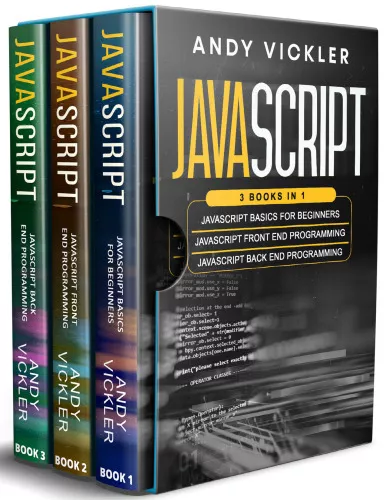
- Author
- Andy Vickler
- Language
- English
- Year
- 2021
- File Type
- File Size
- 8.1 MiB
JAVASCRIPTJavaScript Basics for BeginnersJAVASCRIPTJavaScript Basics for BeginnersIntroductionChapter One: An Introduction to JavaScriptChapter One: An Introduction to JavaScriptThe Developer of JavaScriptThe Use Cases of JavaScriptThe TagDisplayValuesNumbersArithmeticStringsJavaScript ArraysChapter Two: JavaScript VariablesChapter Two: JavaScript VariablesJavaScript IdentifiersDatatypesDeclaration of VariablesThe Undefined VariablesRe-DeclarationArithmeticJavaScript String ConcatenationJavaScript Let KeywordChapter Three: JavaScript ConstantsChapter Three: JavaScript ConstantsBlock ScopePrimitive ValuesJavaScript ConstantsChapter Four: Prompts and ConditionalsChapter Four: Prompts and ConditionalsThe JavaScript if StatementThe else StatementThe else if StatementJavaScript Switch StatementChapter Five: JavaScript Strings and ArraysChapter Five: JavaScript Strings and ArraysThe lastIndexOf() MethodWhat If the Index Is Not Found?The search() MethodJavaScript ArraysJavaScript Array concat()Array SortingReverse GearSorting NumericCompare FunctionRandom SortingArray ValuesObject Array SortingJavaScript IterationChapter Six: JavaScript LoopsChapter Six: JavaScript LoopsThe for/in LoopThe forEach() LoopThe for/of LoopEternal LoopsJavaScript while LoopsThe do/while LoopJavaScript Break and Continue StatementsChapter Seven: JavaScript FunctionsChapter Seven: JavaScript FunctionsThe Invocation of FunctionThe () OperatorFunctions as VariablesLocal VariablesJavaScript ExpressionsThe constructor()Self-InvokingFunctions or ObjectsThe toString() MethodArrow FunctionsParameters & ArgumentsInvocationGlobal ObjectsReusing MethodsChapter Eight: JavaScript ObjectsChapter Eight: JavaScript ObjectsThe new KeywordObject PropertiesThe DeletionDatesJavaScript ClassesPassing ParametersClass InheritanceConclusionReferencesJAVASCRIPTJavaScript Front End ProgrammingJAVASCRIPTJavaScript Front End ProgrammingIntroductionReact AdvantagesReact LimitationsChapter 1: ReactJS - Environment SetupChapter 1: ReactJS - Environment SetupLocal Environment SetupWith Webpack and BabelThe create-react-app CommandChapter 2: Introducing React JSXChapter 2: Introducing React JSXWhy Use JSX?How to Embed Expressions in JSXJSX is an ExpressionSpecifying Attributes with JSXHow to Specify Children with JSXPreventing Injection Attacks with JSXJSX Represents ObjectsChapter 3: All About ComponentsChapter 3: All About ComponentsThe Component LifecycleCommonly Used Lifecycle MethodsLifecycle Methods Rarely UsedError BoundariesClass PropertiesInstance PropertiesChapter 4: State and LifecycleChapter 4: State and LifecycleConverting Functions to ClassesAdd Local State to a ClassAdd Lifecycle Method to the ClassCorrectly Using StateData Flows DownChapter 5: ReactJS Props and PropTypesChapter 5: ReactJS Props and PropTypesUnderstanding PropsWhat Are React PropTypes?Chapter 6: ReactJS FormsChapter 6: ReactJS FormsStep One – Use JSX to Create a Basic FormStep Two – Using Uncontrolled Components to Collect Form DataStep Three – Using Controlled Components to Update Form DataStep Four – Update Form Properties DynamicallyChapter 7: ReactJS EventsChapter 7: ReactJS EventsCreating EventsListening To Component EventsAdding Event ListenersHandling EventsPassing an Argument to an Event HandlerChapter 8: ReactJS RefsChapter 8: ReactJS RefsCreating RefsUsing React RefsIntegration with DOM-Based LibrariesRule of Thumb for Using RefsForwarding RefsChapter 9: ReactJS Lists and KeysChapter 9: ReactJS Lists and KeysRendering Lists in ComponentsAll About KeysChapter 10: ReactJS RouterChapter 10: ReactJS RouterRoutersRoutesSwitch ComponentLink ComponentNested RoutingProtected RoutesCustom RoutesChapter 11: ReactJS – Introduction to FluxChapter 11: ReactJS – Introduction to FluxIntroducing FluxMixin ExampleSyncing with Web APIsChapter 12: ReactJS AnimationsChapter 12: ReactJS AnimationsIntroducing React AnimationChapter 13: ReactJS Higher Order ComponentsChapter 13: ReactJS Higher Order ComponentsHigher-Order Functions in JavaScriptWhat is a Higher-Order Component?Higher Order Component StructureBuilding a Higher Order Component - ExampleChapter 14: ReactJS Best PracticesChapter 14: ReactJS Best PracticesChapter 15: Let’s Create a React AppChapter 15: Let’s Create a React AppStep One: Setting Up a Boilerplate AppStep Two: The React App StructureStep Three: Starting the Development ServerConclusionReferencesJAVASCRIPTJavaScript Back End ProgrammingJAVASCRIPTJavaScript Back End ProgrammingIntroductionChapter One: Setting Up Your Node.js EnvironmentChapter One: Setting Up Your Node.js EnvironmentWindowsMac and LinuxIDE InstallationIDE – Visual Studio CodeHello WorldChapter Two: Node.js - REPL TerminalChapter Two: Node.js - REPL TerminalStep One — Start and Stop the REPLStep Two — Execute Code in the REPLStep Three — Mastering REPL ShortcutsStep Four — The REPL CommandsChapter Three: Node.js - Package Manager (NPM)Chapter Three: Node.js - Package Manager (NPM)Downloads and Installing DependenciesVersioningRunning TasksWhere Does npm Install the Packages?Using or Executing Packages Installed With npmChapter Four: Node.js Callbacks and PromisesChapter Four: Node.js Callbacks and PromisesChapter Five: Asynchronous JavaScript ProgrammingChapter Five: Asynchronous JavaScript ProgrammingSynchronous JavaScriptAsynchronous JavaScriptAsync CallbacksPromisesAsynchronous Code NatureChapter Six: Node.js Event Loops and Event EmittersChapter Six: Node.js Event Loops and Event EmittersPhase OverviewsetImmediate() vs setTimeout()process.nextTick()process.nextTick() vs setImmediate()Chapter Seven: Node.js BuffersChapter Seven: Node.js BuffersWhat Are Buffers?More Fun With BuffersChapter Eight: Node.js StreamsChapter Eight: Node.js StreamsWhat Are Streams?Async IteratorHow to Create a Writable Streampipeline()The Stream ModuleChapter Nine: Node.js File SystemChapter Nine: Node.js File SystemWhat is the Synchronous and Asynchronous Approach?Important fs.module MethodsChapter Ten: Node.js Global ObjectsChapter Ten: Node.js Global ObjectsGlobal ObjectGlobal Modules and FunctionsGlobal ObjectsChapter Eleven: Node.JS Utility ModulesChapter Eleven: Node.JS Utility ModulesOS ModuleOS Module MethodsPath ModuleNet ModuleClass - net.ServerClass - net.SocketDNS ModuleDomain ModuleChapter Twelve: Node.js Web ModuleChapter Twelve: Node.js Web ModuleWeb Application ArchitectureUsing Node to Create a Web ServerMake a Request to Node.js ServerCreate a Web Client Using NodeChapter Thirteen: Node.js Express FrameworkChapter Thirteen: Node.js Express FrameworkWhat is Express.js?Installing and Using ExpressWhat are Routes?Building a Web Server with Express.jsChapter Fourteen: Node.js RESTful APIChapter Fourteen: Node.js RESTful APIHTTP MethodsRESTful Web ServicesHow to Create RESTful for a LibraryList UsersAdd UserShow DetailDelete UserChapter Fifteen: Node.js Scalable ApplicationsChapter Fifteen: Node.js Scalable ApplicationsStrategies of ScalabilityThe Cluster ModuleLoad-Balancing an HTTP ServerBroadcasting Messages to All WorkersIncreasing Availability of the ServerZero-Downtime RestartsShared State and Sticky Load BalancingChapter Sixteen: Node.js PackagingChapter Sixteen: Node.js PackagingPackaging Your Node.js AppPackage Using the Command-LinePackage Using the CodeChapter Seventeen: MongoDB + Mongoose with Node.js – Best Practices for Back End DevelopersChapter Seventeen: MongoDB + Mongoose with Node.js – Best Practices for Back End DevelopersWhy You Need MongoosePerforming Mongoose OperationsPerforming CRUD OperationsConclusionReferences
show more...How to Download?!!!
Just click on START button on Telegram Bot